Saturday, January 21, 2017

The Empress: another look


Why is this Tarot card titled The Empress? What significance does she have in a Tarot deck? For a reality check, who was she in the historical past? Why is she in the Tarot anyway?

The Empress
There are two ways to think about The Empress in the Tarot: One is historical concerning several real Empresses of the past. The other is symbolical and mythological with references to an earlier ancient earth Goddess from the Middle East, Africa and early European cultures. (See my previous BlogSpot article on The High Priestess)

 Historical Empresses were the female sovereigns of past empires, especially the ancient Egyptian Empire; the Roman Empire; Persian Empire; Chinese Empire; and later European Empires, such as the Austrian Empire and British Empire. An Empress was usually the consort of the ruling Emperor but, in some cases, she was the supreme monarch, governing and having the power to command armies and rule other kingdoms. This was a position of power that was very rare for women in a male-dominated hierarchy of rulership. Empress Wu Zetian (625–705) ruler in the Tang Dynasty of China, achieved her power by eliminating her enemies in taking over the throne after her husband died. In a monarchy, the title Empress or Emperor is superior to a King or Queen, and the Empire is larger than a kingdom, sometimes incorporating many entire city-states. And the last historical Empresses are not too far in the distant past. British Queen Victoria, Empress of India, ruled many colonial countries around the world and she died in 1901. Her granddaughter, Alexandra, was the last Tsarina in Russia and she was murdered in 1918 with her family and spouse Tsar Nicolas I, during the Russian Revolution and overthrow of the Russian Empire. In some ways, it is hard for us to comprehend how such power was exerted in the past, which is the very reason that The Empress and The Emperor are part of the more traditional Tarot deck: emphasizing vast powers, supreme leadership, and control of their subjects.  

In a contemporary context, some Tarot decks present The Empress as the Great Mother Goddess, as in The Motherpeace Tarot by Vicki Noble. This deck exemplifies the resurgence of the modern Goddess movement in Feminism. In certain “back to nature” communities, the Goddess is viewed as immanent in nature with all its processes; therefore, most of nature’s functions on earth are regarded as sacred: cell-division and the self-generating processes of plant growth and seed-bearing; the fertility and abundance of crops; the sustenance of water; the reproductive and formative processes of animals and birds.

Archaeologist, Marija Gimbutas, in her extensive book, The Civilization of the Goddess, talks about the veneration of an earth Goddess in Eastern European prehistory who was represented by small clay female figurines found everywhere, particularly in areas that appeared to be temples. Archaeological evidence points to agricultural communities at least as far back to the 7th millennia B.C. where agrarian cultures were [thought to be] more ‘gynocentric,’ and women reflected the “sovereignty of motherhood,” she says. These little figurines were found by the hundreds at digs mostly in Eastern Europe.
Ashera

“In Gimbutas’ view, old European female imagery expresses metaphoric concepts of sacred cosmology within a mother-kinship culture.”
(The realm of the Ancestors, Ed Joan Marler)

In another sense, there are derogatory Biblical references to the Middle Eastern goddess Ashera, or Ashtoreth/Astarte, a Canaanite Goddess worshipped as far back as 9th century B.C.; yet, in contrast, she was revered in Ugaritic legends and mythological texts from Ras-Shamara, discovered in Syria. In I Kings 18:19, worship of the goddess instead of the one God by the Hebrews was blamed on Jezebel, and in Deuteronomy 12:3, the destruction of a statue of Ashera was demanded by burning it. Ashera was condemned by the Hebrews as one of the gods to eliminate. These religious beliefs and the story of Eve’s downfall and deception, paved the way for many centuries of treating women as second class citizens and subordinate to men. Then there was Ishtar of Nineveh. She was the goddess of the Akkadian pantheon and was written about in the Epic of Gilgamesh, a poem inscribed in cuneiform on clay tablets around 3,000 B.C., where the goddess, Inanna, descended into the underworld; was killed by her sister Erishkigal, and resurrected by her priestess and companions. She was more of a warrior goddess of fecundity and procreation. (Descent to the Goddess by Sylvia Brinton Perera)

What meaning can we extract from The Empress card in a reading? She represents leadership in the community; self-respect as a liberated person free from dehumanizing oppression; exhibits mature judgment, and is not afraid to speak up against injustice. Her attributes are that of a self-actualizing person who is supporting, caring for, protecting, and nurturing her community. In a broader sense, she is the goddess of fertility, birth, motherhood, love, and the abundance of nature.

“The power to regain our own life comes from the discovery of the cosmic covenant, the deep harmony in the community of being in which we participate.” (Mary Daly, Beyond God the Father, Beacon Press, 1985)

When you get The Empress card in a reading, ask yourself these questions: How are you being an Empress in your life in taking charge and demonstrating leadership in your community? Are you speaking up, resisting, and pointing out injustices? Are you nurturing and caring for your family and friends? Are you helping to eliminate oppression, violence and war? What are you doing to promote the common good for everyone?


Saturday, December 10, 2016

Revisiting The High Priestess


     What does the future hold? Will there be world war? Will the economy collapse?
In antiquity, leaders, politicians, and the public probably asked the same questions when they consulted the priestess at the oracle. These questions were often answered by “wise women” in early cultures. Modern day concerns probably aren’t much different than the issues of the day in 7th century BC, when, today, we consult astrology charts and have tarot readings as we seek other options and new perspectives on things.
High Priestess TOCC
     In contemporary interpretations of The High Priestess in Tarot, the basic meaning pertains to listening to your intuition and paying attention to the inner voice within. When you meditate on the High Priestess card in Tarot of Cosmic Consciousness, think of directing your thoughts to a deeper place, and connecting to an inner spiritual language. Metaphorically, she represents a portal, so when you step between the dark and light pillars and cross the threshold in your mind, you may open stored buried memories and repressed emotions, symbolized by the little rainbow colored vessels.  
Venus of Wilendorf
     Many concepts of the priestess’s role have been written about in historical mythology, from the study of early Goddess worship and the role of sibyls in ancient cultures, to modern day Wiccan practices. For some, it is rediscovering the feminine side of God.

“The Goddess image implies a new feminist matristic consciousness at the same time that it reveals a new knowledge of our most ancient historical past.”
Gloria Feman Orenstein, The Reflowering of the Goddess (Pergamon Press 1960)

According to early Greek writers, the “Oracle of Delphi,” was tended by the Pythia, a priestess, who sat on a tripod over a crack in the earth, supposedly entranced by fumes where she related the prophecies or advice of the gods. The story goes that the site was originally built for the Great Earth Mother Goddess Gaia, but was taken over by Apollo after he killed the giant python guarding the site. Thereafter, the priestess was channeling the voices of the gods, especially Apollo.

 Obviously, in our scientific age, we have come a long way from worshipping the old gods. In Tarot, we have the remnants of what the goddess and her priestess once stood for. She represents the gateway to one’s spiritual being and discovery of the Feminine Principle, the formator of life. In a reading of the High Priestess, we are connecting to something beyond our daily lives and attuning to cosmic patterns of life. Symbols and signs discovered here can be divine messages from our Cosmic Selfhood.  This is often symbolized in art, music, dance, poetry, prose, religious ritual, and the spoken word.

Early Priestesses in Art and Literature
1.      Paleolithic times, (30,000 BC to 10,000 BC) small fertility goddesses held in the palm celebrated the great Mother Goddess.

“As in Paleolithic art, female figurines and symbols occupy a central position in the art of Catal Huyuk, where shrines to the Goddess and Goddess figurines are found everywhere.” Raine Eisler, Chalice and the Blade (HarperCollins, 1987)

2.     Neolithic times (10,000 BC to 2,000 BC)
Ancient Middle East: Cuneiform stories written on clay tablets such as “Descent to the Goddess” was about the Goddess Inanna (Ishtar or Ashteroth) and her trip to the underworld guided by her priestess Ninshubur. Here she confronted death and resurrection. Reference: The Descent to the Goddess, Sylvia Brenton Perera (Inner City Books, 1981)

Malta, Hypogeum: (around 3,000 BC) An elaborately carved underground sanctuary/tomb with an oracular hole where a voice could be projected throughout. Small sleeping ceramic goddess figurines were found there – the priestesses were probably acting on behalf of the Goddess - was this figure a depiction of drug induced dreaming/visions, prophesizing? It included a snake pit – for snake bites to enhance the visions?  Reference: “Sanctuaries of the Goddess,” Peg Streep (Little, Brown and Company, 1994)

3.     Biblical, mentions goddess worship of Ashteroth (around 1000 BC) (Judges 2:13; 10:6) Israelites broke their covenant with God and worshipped the gods of the Canaanites, Baals (male god) and Ashteroth (female goddess)

4.     Egyptian (New Kingdom – 19th Dynasty (1550 BC) – celebrated the Egyptian goddess Isis. Priestesses were living representatives of Isis. Tomb paintings in the tomb of Nefertari show her as priestess giving offerings to the goddess Hathor

5.     Early Greek and Roman cultures: Elaborate temples and realistic sculpture to portray and celebrate the gods (450+ BC)
          Greek statues were thought to be temporarily inhabited by the gods.
          Greek – (4th century BC) Oracle of Delphi – Pythia priestess for Gaia/Apollo
          Roman – Priestesses of Vesta performed rites to regulate water-supply
                 Reference: “Oracles and Divination,” Michael Lowe, Carmen Blacker (Shambhala, 1981)

6.      Early European earth worship – (up to the 11th century when Latvia was the last country to be Christianized) There were ritual dances and celebrations of so-called pagan religious belief in early European tribal cultures. The Earth Goddess was immanent in nature represented by “wise women” who saw earth with sacred places and sacred springs, attended by women at the well; sacred stones, nooks and crannies, and sacred forests. There were Wiccan Priestesses, matres familiae (older women casting lots) – such as Volva, Voluspa, Norwegian; and Veleda, Eastern European women representing the Mother Earth Goddess.

“That Anglo-Saxon peoples invoked a mother goddess at plowing and seeding is proved by an early medieval plowing charm recorded ad preserved in a manuscript in the British Museum.” Pamela Berger, The Goddess Obscured (Beacon Press, 1985)
Reference: “The once and future Goddess” Elinor Gadon (HarperCollins, 1989)

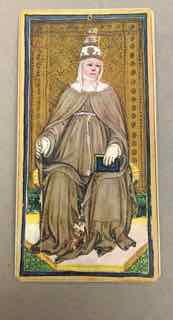
7.     Middle Ages Europe: (11th century to 15th century) various oracles of prophecy spread throughout Europe: astrology charts, tarot card paintings on cardboard; Norse carved signs (Runes) on Rune Sticks and Tarot decks of the 15th century: Parts of the Visconti Tarot deck of 22 Triumphi are held in the collection of Pierpont Morgan Library in New York. It was thought to be painted around 1400 -1466. The Visconti High Priestess is depicted more as a Popess with a 3 tiered Tiara. Reference: Visconti Tarots, Giordano Berti/ Tiberio Gonard (Lo Scarabeo, Turin 2002)

So you might ask, “Why are we looking back at priestesses of the ancient past”?
Visconti High Priestess
In today’s feminist mood, it is part of the search for lost feminine wisdom, which has been suppressed, forbidden, cast aside, and extinguished over the centuries. We can see that an acknowledgement of the feminine has been re-emerging in the 20th century and continues more than ever now.  It includes a recognition of our dependence on this sacred mother earth who is currently being devastated by wars, blasted and drilled for her precious resources, and trampled upon disrespectively in most all countries.  When you get The High Priestess in a reading, take time to pause and rethink your relationship to the earth; the safety of the food you eat; the water you drink, and your role in acting on your intuition. What is your “gut feeling” to do the right thing – without mad ambition and greed, selfishness, or political motivation? It’s a time to get in touch with the truth and goodness of your real self.


Sunday, October 9, 2016

Magic and The Magician in Tarot

     The Magician

The Magician in
Tarot of Cosmic Consciousness
Let’s get to the core of this discussion right away. The first thing we need to consider is that the power of human imagination is capable of imagining anything. The next thing to consider is the power of belief. We are capable of believing just about anything. The best part of this is acting on our beliefs, and that’s where the Tarot comes in.

Today, people use the Tarot card symbols for stimulating and inspiring our creative imagination. Each card with its specific meaning can help us understand our subjective experiences. In our modern society, very few people actually practice magic because we think we must be rational about everything. At least some of us would like to believe that. Richard Tarnas in his book “The Passion of the Western Mind,” discusses the foundations of the modern world view since the 17th century:

“…the order of the modern cosmos was now comprehensible in principle by man’s rational and
empirical faculties alone, while other aspects of human nature emotional, aesthetic, ethical, volitional, relational, imaginative, epiphanic were generally regarded as irrelevant or distortional for an objective understanding of the world.” P. 287

He regarded this as, “…mechanistic principles having no special relation to either human existence per se, or to any divine reality.”  (My note: This view dismisses and discounts any other view, so there! they say!)

In the ancient past, early peoples believed in mythological, supernatural, or as we might think of, imaginary beings with magical powers.

Who or what is The Magician card and what is magic?
In ancient times, magicians, or shamans, medicine men/women, conducted ceremonies and rituals hoping to bring forth other worldly beings with superhuman powers, and in some cases, demonic powers, to solve all our problems. According to Sir James Frazer, author of “The Golden Bough,” early peoples practiced magic in Mesopotamia, Persia, Egypt, Asia, Greece, Rome, and other European countries, and his entire book discusses what they did. We are astounded by the range of practices performed by the Holy Man or Holy Woman.  Most magicians were trying to influence these illusive intermediaries through rituals and spells. In earth magic, nature worshipping pagans were conjuring the deities of rocks, trees, plants, water, and animals, to act on their behalf to help them and grant their wishes: ethereal tree spirits, plant devas, and fairy-folk.  Giant stone circles were constructed in sacred places where seasonal rituals and ceremonies probably took place. Native Americans invoked weather-related spirits of wind, rain, lightning, and animals and plants, where they danced in kivas wearing masks that represented certain spirit beings. Their art reflects this in totems and kachina dolls. All this was to bring about different states of mind and a transformation of consciousness in order to exert power over the environment, over other people, and unknown forces. They also included dream and vision interpretation in their magical practices.
  Later, in Medieval European magic (before the 17th C) and in some kinds of hermetic magic, special incantations were used to create or bring forth supernatural effects using charms, amulets, talismans, and spells.  In an opposite context, a more sinister shadowy world of malefic concoctions was created in “Black Magic,” with spells invoking “unclean” spirits to inflict pain and bring misfortune upon others. And then there were the charlatans, soothsayers, and street magicians who performed seemingly magic tricks for a coin or two by slight of hand.
In modern thought, for most of us, it is almost impossible to go back to the methods of the ancient past and actually participate in ritualistic magic. We just don’t believe in it as our ancestors did. Why? Because they really believed in what they practiced.

On another note, concerning empiricist thinking, Rene Eisler in her book “The Chalice and the Blade,” discusses The Failure of Reason:

“Finally, after Auschwitz and Hiroshima, the promise of reason began to be questioned… How could one explain the carefully reasoned military experiments of the effects of the atomic bomb and radiation on living and totally helpless human beings? Could all this superefficient mass destruction be called an advance for humanity? 

Where does the Tarot fit into all this? Tarot practitioners feel there is more to life that just what goes on in our everyday materialistic working world. Some want the adventure of the mind, and sense the importance of human imagination that transcends human knowledge. Some like to find meaning in the magic of mystery, randomness, and creative thinking. Others just want to overcome the boredom of deterministic thought.  
The meaning of The Magician in “Tarot of Cosmic Consciousness” is about the work one does to discern the difference between reality and unreality, the truth and a lie. One can become more open to “the heavens above,” so to speak, and can be a conduit for Cosmic Energy. Here one focuses on self-transformation by using the “tools” of Tarot: Wands- establishing one’s true identity; Cups-finding an inner life; Swords-having creative ideas; and Coins or Pentacles-putting your best foot forward in the physical manifestation of your own persona.
My teacher, Gail Fairfield, discusses The Magician in terms of psychological insights in her book “Choice-Centered Relating and the Tarot.” The key is discernment. [It represents] “People: Who are analytical, problem solving, discriminating, discerning. [They use] Information: That is factual, that dispels illusions, that gives answers.” Any magic in that is found in how you interpret the insights and real facts about your situation and experiences. The choice of solutions is up to you.  The best part is that you take responsibility to work it out for yourself without other worldly beings stepping in on your behalf. It’s really up to you.

Now I will go out and check on the gnomes guarding my garden, just in case.